| |
Third son of Alfred Ernest Jewell and Matilda Alethea Rodda
Harold Henry Jewell 1909-1995
Jewell, Harold Henry – Born 7th August, 1909 at Jandakot,
West Australia. Christened in the Methodist Church, Fremantle.
Leaving West Australia in 1913, the family arrived in Melbourne in June of that year,
settling in Thornbury. In January 1914, Harold commenced school at Wales Street State
School No. 3139 where his total education took place earning the Merit Certificate in his
final year. Attending the Methodist Sunday School it came as quite a shock when in
1916, his eldest brother, William, went to The Salvation Army and it was not long before
the whole family became immersed in their new “church”.
Commencing work at 14 years of age as a wheelwright, Harold held three jobs during
1924 and in January 1925 became an employee of The Salvation Army Printing Works
(now Citadel Press) where Colonel John Osborne was manager. At 15 years he made a
resolution to one day become the proprietor of a business and with this in view,
dedicated his talents to becoming proficient in the printing trade. Twenty-three years
later (1948) saw the culmination of his dedication when, with a friend, he purchased a
business which was established in 1873, and recognised as the oldest suburban printing
business in Melbourne. After 28 successful years he retired in July 1976.
Married in 1933, his wife Jean, was the youngest daughter of Colonel and Mrs Henry
Sharp. She also worked at The Salvation Army Printing Works and they were the first
couple to be married from that establishment.
Taught the rudiments of music by Walter Clark, the first bandmaster of Thornbury
Corps, Harold commenced playing in the band under Jim Berry at 13 years of age. His
banding experience took him to all States except West Australia. In 1949 he enjoyed the
distinction of being a member of the Thornbury Band when it chartered an aeroplane
for a campaign in Tasmania. This was the first time that a Salvation Army Band had
chartered a plane in the Southern Hemisphere.
Drafted into the Military Forces in 1927, he was a member of the 57th Battalion Band
which won Military Band Championships in 1928 and 1929. It was also the first
Military Band to broadcast in Melbourne and in that same year appeared on Movietone
News doing ceremonial marching. Banding included 11 years on EEb bass, 8 years on
euphonium and the last 17 years on solo cornet in The Salvation Army Band at
Thornbury Corps. After 40 years banding he prematurely retired following two heart
attacks. As a treasurer he gave 23 years to Thornbury Corps and in that time spoke on
Planned Giving to a number of Corps in both City and Country, even addressing three
Officers’ Fellowships on the subject.
As a Life-Saving Scout he was a member of the Territorial Trumpet Band and in 1924 was
part of the Guard of Honour at Spencer Street Station to welcome General Bramwell
Booth.
In addition to being the proprietor of a printing business, he was for many years an
Honorary Justice of the Peace and in 1991, as a guest of Rotary International was presented
with a Certificate for Community Services.
Commencing in The Salvation Army at Thornbury in 1916, Harold is still a soldier of
the Corps in this year of 1994. In retirement he lives at Inala Village and for recreation
plays lawn bowls.
This is Harold’s story:
To introduce my own life, I must first introduce you to my parents, Alfred Ernest and
Matilda (Tot) Alethea (nee Rodda) Jewell. My mother was born at Stawell, a Victorian
country town where her father was a miner. However, he had a serious accident in the
mine which left him with a permanent disability so they moved to Collingwood where
he opened a smallgoods shop. My father was born at 3 Bent Street, Northcote. His father
being an engineer, Ernest was to follow that profession, but the news that Tot’s health
was in danger unless she moved to a warmer climate precipitated their marriage and
a move to West Australia where it was rumoured that you could ‘pick up gold in the
streets’. Of course, this was not so and my parents finished up living in a tent in
Northam. My father’s brother, George, and his wife, Elizabeth, also went West but
quickly returned to Victoria. It was in this tent that my eldest brother, William Ernest
was born February 5, 1904, an aboriginal lubra attending my mother as mid-wife. My
other brother, Leonard James was born December 28, 1905 at Northam, too, but in better
circumstances. In the meantime, my father had secured work as a fettler in the railways
where he travelled hundreds of miles on the hand-operated 2-man trolleys used by
maintenance men on the railway tracks in those days. I used to love to hear his stories
of those trolley rides and as a child they fired my imagination as a fantastic adventure
when in fact, it was pure hard work.
I should point out that living in a tent in the bush wasn't easy on my mother. She had
to contend with the loneliness of really being alone with nobody living nearby, in fact,
her nearest neighbour was roughly a mile distant, so you can imagine something of her
situation. About 50 yards from the tent was a bush track which the camel trains used
when the Afghans were travelling north with their goods, and when my mother heard
the camels coming she would run into the bush to hide because she was afraid the
Afghans would kidnap her and take her with them. When Will was born she also took
him into the bush to avoid the Afghans. Indeed a traumatic experience for a young
woman alone in strange surroundings with no neighbours nearby if assistance was
required. However, in later years she found there was no record of the Afghans
molesting lonely women.
It was during this period that soldier ants attacked Will in his cot and had my mother
not heard his screams it is likely they would have killed him. These soldier ants were
huge being an inch (2cm) or more long and when on the move they covered the ground
like an army, attacking and devouring anything and everything that stood in their path.
Animals would even avoid them. Another incident involving Will was when a
venomous snake came between the cot and our mother — she seized an axe and
chopped the snake.
It was not long after Len was born that my parents moved to Serpentine which is now
a reservoir for Perth. It was here that Emily May was born May 17, 1907, and being the
only girl, she was zealously protected by parents and brothers alike. Whilst May was
still a small child and another baby was expected, a fire completely burnt out the home
at Northam. My mother, who was an expert machinist had just received from my father
a lovely new Singer sewing machine fitted into a beautiful cabinet which, when opened
gave bountiful bench space for my mother to lay out her sewing — she was so skilled
that many of my father’s shirts were made by her together with all our children’s
clothes. However, when it was apparent that the fire would destroy everything, my
mother cried out, “Ern, please save my machine!” At great risk my father raced into the
burning building and managed to get the machine out.
The family subsequently moved to Jandakot, a little town between Perth and Fremantle
and it was here that I, Harold Henry was born on August 7, 1909. Jandakot is now an
airfield similar to Moorabbin in Victoria. I should tell you how the name of Harold
Henry was bestowed on me! At first my mother wanted to name me Horace - my father
objected - then it was to be Hector - again an objection - so finally my mother said,
Harold Henry so at last my father agreed even though he must have had reservations for
I never recall him addressing me as Harold, it was always “Lal”, so I guess that was a
way of permanently registering his protest at my mother’s choice of a name for me. The
other boys had received family names. By the way all we children were reared on
Nestle’s Condensed Milk which would be delivered by the case from Perth at regular
intervals.
I have no recollection whatsoever of life in West Australia. When I was three years old,
approaching four, my parents decided to have a holiday back in Victoria, so we
embarked on a ship at Fremantle and my very first remembrance of life at that age was
when I lost a ball overboard. In retrospect, I think my parents would sometimes have
wished for me to fall overboard too — I was a bad-tempered little brat.
The holiday in Victoria was such an enjoyable experience to be with the family again
– that my parents decided to remain in Victoria, so my father returned alone to the West
to wind up affairs in that State, whilst we settled into the Victorian life-style. On my
father’s return we moved into a house at 53 Darebin Road, Thornbury, and a few
months later my parents bought 55 Darebin Road into which we quickly moved. My
first recollection of that house was finding a ½d. on the floor. Big deal, you say, but in
those days a ½d. to a child was a little fortune. Remember, this was 1913. At that time
55 was a shop so my father opened a greengrocer’s business and successfully traded
there until the bubonic influenza in 1919 which destroyed the business and that of many
others. But that is another story.
In January 1914, I commenced my schooling at Wales Street State School, No. 3139 and
that first day I well remember, because with others I was introduced to a new way of
life. There was a headmaster over the whole school and a headmistress over the junior
school. She was very kind but later, whilst not a tyrant, I found her to be a strict
disciplinarian. Do we need this today? Well, I found school a most enjoyable experience.
Certainly as most boys do, I had some troubles with teachers from time to time and
when it appeared a joint effort, I was usually paraded with three or four other boys as
ringleaders. Mind you, I did “wag it” occasionally because in those days a fair bit of
water flowed in the Darebin Creek and we used to like to swim in what we called “the
devil’s hole.” Our parents, as well as the teachers, forbade us to swim there but, of
course, boys will be boys! When I became one of the “big boys”, I was fortunate to
represent the school at both football and cricket and in those days it was a case of
walking to your away games, so when playing Heidelberg School we would trek across
the paddocks to Warringal Park, play our game, then trek back home again. I can
imagine the attitude of parents today if their child was asked to walk that kind of
distance. We also had to walk to Fairfield Park and to Westgarth Park. All in the name
of sport!
However, one of the outstanding events of school days was my appointment as captain
of the tunnel ball team in the school sports. We were successful in winning the
championship at the district sports and were looking forward to the metropolitan
games when our anchor-man, Kevin Philbrick, offended the sportsmaster and was
suspended from the team. We called a team meeting and it was decided that as captain
I would confront the sports-master to indicate that if Philbrick was out of the team, we
would go on strike. It is one thing to be brave at a meeting and another when it is time
for confrontation, particularly when that person is tough. I was to do it at practice the
next day, but just before we went to practice the sports-master said, “Philbrick, take
your place in the team!” Wow, what a relief! Unfortunately we only gained second
place in the metropolitan sports.
Amongst my not-so-good habits was fighting. My father always told his boys that you
never give in no matter how big the other boy may be and to back it up he taught us all
to fight to protect ourselves. My brothers used it that way and very effectively, too, but
being a hot head I carried it further and was therefore mixed up in quite a few scraps.
Indeed, I even fought a “friendly fight” with a mate just to prove who was the better
fighter. We fought after school for three nights — both finishing each night covered in
blood, much to the disgust of our mothers, then we decided to call it a draw and resume
our mateship.
In my childhood we had to create our own fun. I do admit, however, that we did have
more scope for our activities. Traffic was not so dense, with mainly horse and cart and
there were plenty of vacant building blocks for football and cricket and at the rear of
most houses was a laneway (originally for use of the night cart) where we had ample
space for a game of tally-ho. You may ask, What is tally-ho? We formed into sides and
one would race off down the lanes, into streets, across vacant blocks calling “tally-ho”
and the opposing side after counting 20 or more would chase in an attempt to catch the
others before a given time. There is no scope for such a game today. Of course marbles
were a very popular pastime and I managed to be reckoned champion of the big ring,
my main “tor” being a “real” which belonged to my father when he was a boy. It is now
well over 100 years old (1988) and is in the possession of Maralyn. Cherry-bobs was
another game played with cherry stones which we sometimes coloured by dipping
them in red, blue or black ink. Cigarette cards occupied many hours and this was
played by flipping the cards towards a wall, the person getting nearest would then
throw all the cards being played into the air keeping those which fell face up. Each
would throw in turn. On vacant blocks, leaning against a fence, we would play “saddle-me-nag” and it is amazing that we didn't get bad backs out of this exercise.
We talk of fun! More people used footpaths in those days so we would place a blown-up paper bag on the footpath with half a brick inside. We would then hide behind a
hedge (nearly every house had one) and sure enough somebody would come along and
kick the bag. To drop a coin today is not important, but back in those days, all coins
were important, so we would hide behind a hedge, drop a coin on a brick and enjoy
watching the person searching for a coin they hadn't even dropped. Shop verandahs
had supporting posts, so we would choose a fence post near that verandah post to place
a jam tin of water around which we would tie some cotton and attach it to the post. Hey
presto, when somebody came along they had a bath. Not a very good trick at all and we
were chased a few times only escaping through the labyrinth of vacant blocks and lanes.
We played some other annoying games, but we never indulged in vandalism other than
possibly knocking out a few street globes, or if somebody aggravated us, they would
get a few stones on their roof. In those days roofs were all galvanised iron, so stones
made a noise.
We all as children, had a chore or chores to do. It was the days before toilet rolls were
introduced and one of my jobs was to ensure that there was sufficient toilet paper, so
each week would see me cutting newspaper into manageable squares, punching a hole
in the corner and threading string to hang it. Woe betide me if we ran out of toilet
paper. Incidentally, in those days, the toilet (we called it the lavatory) was detached
from the house by a regulation of at least 10 feet and in place of a press button the flush
tank was mounted above head height and operated by pulling a chain to operate the
flusher. I recall how scary it was if nature called during the night and I had to venture
out into the cold. When I turned the key in the lock on the back door it nearly always
took my breath away — it was about a 30-yard walk and remember, no light. Fear of
the dark, fear of spiders, and they seemed to breed rapidly in toilets, was an ordeal for
little boys. Sometimes I stole matches to light up the toilet — a dangerous practice really
not permitted by my parents. How lucky kids are today!
My father was a great man with his boys. He would play marbles with us, play football
and cricket, was interested in our every day doings, he even taught the three boys a
little about boxing, as he said, “not to be aggressive, but to be able to protect yourself!”
However, he was a bit of a tyrant and if he said black was white, so be it! We were not
allowed to put our arms or elbows on the table during meal times, so in turn we all sat
alongside him and when we inadvertently put any part of our arm on the table, it was
removed by a swipe from him. We very soon learned table manners.
On Saturday afternoons we often went to the pictures at Northcote or Thornbury which
cost 3d. entry. They were silent movies and on Saturday afternoons the show was
mainly Cowboy and Indians or comedies. The movies were silent, but we kids weren’t
very silent. The night shows were more selective and cost more because every theatre
had an orchestra and often attendances were affected by the quality of the orchestra. I
used to get very angry because just about the time to leave for pictures or football, my
father would make me get out my truck and go for more ice-cream. This could make me
late, so my Dad was called a few names (he didn't hear) whilst I raced to the ice-cream
manufacturer’s on the corner of Dennis Street and Salisbury Grove. Normally, I picked
up the time by “whipping” the cable trams and I reckon my father had a fair idea of my
movements! I should say that at the time my parents had a greengrocers business where
they also sold sweets and ice-cream. On Sunday mornings the left over ice-cream would
be liquid-like milk and we kids used to vie for the privilege of drinking it. Really, it was
luscious for ingredients were better in those days.
To sum up my school days, I received all my education at Wales Street State School No.
3139, commencing January 1914 at four years and four months, finishing December 1923
at 14 years and four months. Only two headmasters were in charge during that time,
the first was Mr. Hardess and the second was Mr. Osborne. This was great for it gave
continuity to our studies and teaching methods. Mr. Osborne was tough and for some
time we kids reckoned he was a “Hun” (German), our reasoning being flavoured by the
fact that he came at the conclusion of World War 1. However, in the final analysis he
turned up trumps.
Monday was always a thrilling experience when the whole school, staff and pupils,
formed into classes around the flag pole when we saluted the flag and sang the National
Anthem, then the bugle band and drums marched us into school. It was tremendous.
What a pity this has been abolished, for in those days there was more loyalty than is
evidenced today.
During these school days we lived at 55 Darebin Road, Thornbury, indeed it was the
family home for 52 years until my sister, May and her husband Perc left it in 1965. I well
remember Victoria Road being the first thoroughfare to be laid in concrete, popular
belief was that it would break down very quickly, but today, 1991, that concrete road
is taking heavier traffic than was envisaged when it was laid. Below Victoria Road there
were no made streets — just cart tracks to the old house or two built on what was then
termed “The Flats”. When I was about six years old the bridge in Darebin Road linking
Northcote and Ivanhoe was built, hence the change of name to Livingstone Street on the
Ivanhoe side of the creek which in those days had a fair amount of water running thru
it, indeed, just below Claredon Street was “The Devil’s Hole” where we boys used to
swim. They were great days and we spent a lot of time walking over “The Flats” and
playing around the creek. There were yabbies in it which we enjoyed catching, but the
best yabbies were in the Merri Creek, the extreme west boundary between Northcote.
Of special interest was the bubonic influenza which hit Australia in 1919. It was a killer.
All public indoor meetings of any kind were banned. Many people walked the streets
and rode in public transport wearing masks on their faces. It was compulsory for
everybody to be inoculated. State Schools were closed to students, however, because of
over-crowding in the hospitals, many schools were opened as hospitals. My eldest
brother, Will, was hospitalised in the Hutton Street State School. The demand for beds
was so great that the Exhibition Building was used as a hospital too. It seemed that
people “died like flies”. My parents sent May to our Aunty Jane at Edithvale to escape
the plague. She escaped it! At 55 Darebin Road we became sick — the doctor came —
my father had the flu, I had it, but when the doctor turned to examine Len he was gone.
The doctor went looking for him and there was Len, hiding under the wagon — he also
had the flu. Next the ambulance came and took the three of us to the Royal Exhibition
Building, we were put into beds with one son each side of their father — a unique sight.
There were rows upon rows of beds with just a moveable partition erected between the
women and the men. Adults and children were accommodated together, Here, at 10
years of age, I learned a lot about death. Every day bodies were removed and that bed
was quickly filled with another patient. It was a terrible sight. They would put the body
on a stretcher, cover it with a sheet, and march it between the rows of beds to a holding
room. I guess it was a case of who will be the next!
I spoke earlier about my parents being greengrocers. This bubonic influenza ruined
them because wherever a food business was stricken, they were no longer permitted to
sell and added to that, there was no Government assistance — it was just a case of
closing down.
I had a particular mate, George Smith. We lived near each other and both were keen
sportsmen and represented our school at football and cricket. One holiday we decided
to learn left foot kicking, so spent the whole day kicking left foot only. We became very
versatile and could kick for goal with either foot. Today, of course, footballers must be
able to kick with both feet. George finally played full back for Preston VFA team. I
broke down with a knee injury which plagues me to this day.
It is my opinion that the evenings spent around the table after our evening meal gave
impetus to our education, because as a family, we would listen to the radio and then
absorb ourselves in books. One of the greatest educators is reading.
Discipline at home and away from home was important in our education and our
parents say to this aspect. If we “spoke back” to my mother and it was heard by my
father, it was woe betide the offender.
I should have told you that my religious education commenced at Prince of Wales Park
Methodist Sunday School but at 7½ years of age (1916) I changed course and went to
The Salvation Army on the corner of High and Gooch Streets. That is a story in itself,
and perhaps if room permits, I may be able to elucidate on it. However, I am proud to
say that today I am a Salvationist and I am quite certain that God has ruled my life and
that His guiding hand has ever been before me. Incidently, at 13 years of age I
commenced playing in the Thornbury Hall Band, playing 2nd Tenor horn. Later a stint
of 11 years on EEb bass preceded eight years on euphonium and finally 17 years on solo
cornet, retiring after 40 years active bandsmanship. My retirement was brought about
by two heart attacks in the 1960's.
During my school days I did a morning paper round at Doubleday’s Newsagency in
High Street for which I received 2/6 (25 cents) per week. At that time there were only
two morning papers: “The Age” and “The Argus”. My round was bounded by Darebin
Road to the north, Dennis Street to the south, Wales Street to the east and High Street
to the west, including all the cross streets between that area, a prodigious task for a
schoolboy. When Mr. Doubleday gave his boys 6d. rise, we became the best paid
newsboys in Northcote and Thornbury area. Other proprietors very soon followed suit.
To finish school memories, as a scholar I was fortunate to be amongst the top half of my
classes which pleased my parents very much indeed. The 8th Grade was the highest
level in State Schools with the merit Certificate the ultimate goal. Because my marks
were good throughout the last year, I was fortunate to be recommended by the
headmaster for the Merit Certificate, but it was first necessary to sit for an examination
set by him. This proved to be harder than the actual merit Certificate examination, so
those who earned the recommendation were proven students. I should add that not
many passed the headmaster’s exam, but they had a second chance by sitting for the
actual Merit examination. I did miss about half a year’s schooling at about 4th and 5th
grade level when hospitalised for peritonitis and later diphtheria.
At 14 years of age I left school with my parents asking if I would like to go to High
School, but I preferred to go to work. Possibly, I should have gone to High School, but
in retrospect, I feel it must have been a relief to my parents, for money was a bit short
at that time and children went to High School totally at their parents expense. They also
wanted me to learn the piano, but I thought that was “sissy” and declined. How stupid!
I have regretted ever since that decision.
I should mention here that I was an avid Scout. My brother, Will, was the Scout Leader
at Thornbury, so it was difficult for me to make headway easily, but having achieved
the status of First Class Scout and wearing about fifteen proficiency badges on my
sleeve, I was appointed a Patrol leader. There were 60 boys in the Troop. Some years
later I became the Leader of a Cub pack and it was in this capacity that my scouting
days were so beneficial.
In those young years we had a very happy family life. My parents were interested in
their children in a very definite way. They encouraged us to talk to them about school
and our mates, about any problems we felt were a threat to happy living. They
encouraged us to bring our friends home for them to meet. They played with us in the
back yard and at table games around the kitchen table in the evenings. Above all, they
were insistent that school home-work had to be done when we arrived home from
school before going out to play. When I started to learn playing an instrument, this
applied also to my practice. I must admit to a bit of cheating there — when my mother
didn't hear the instrument she would come to my room to see why I wasn't practicing.
I would be laying on the bed, ostensibly studying theory, but under the pillow was a
book. The sound of her hand on the door knob was sufficient for me to exchange book
for music theory! They were very fair in dealing with us — we received what they
promised; if it was a book, or a game, or an outing, or clothing, whatever was promised,
we were never denied it. This also applied to a hiding with the strap. If promised a
hiding when we arrived home, no matter how happy the home-coming, we received
that hiding!
The boys were not allowed to enter May’s bedroom, so when she was in trouble with
her brothers she would race for her room — our job was to get to her before she made
it. I seemed to be her main opponent, so if I chased her inside, a yell that “Harold is in
my room” would soon bring the wrath of my mother on my head. On one occasion,
when I chased her, she just made it, so I decided to wait outside the door until she re-appeared. However, after a few minutes the door quickly opened and a little fist went
“bang” on my nose causing me to retire to the bathroom with a bleeding nose. Even
now, May loves to tell that story. I was the bad tempered brat of the family and earned
more thrashings than all the others put together. In retrospect, I certainly deserved
them.
WORK
The first job I applied for was at a Singer Sewing Machine shop in High Street,
Northcote, where I was required to do a writing and arithmetic test. They were a long
time deciding, so, would you believe it, the day I secured a job at a Wheelwright’s in
North Fitzroy, a representative from Singers called on my mother to say I had the job.
When she told him I was already working he abused her. In those days you commenced
work “on the spot”. For your information, a wheelwright made wooden wheels and the
metal threads which were used on bakers’ carts, drays, lorries, buggies, jinkers, etc. It
was a very dirty job, so I didn’t stay long but managed to secure work in Little Bourke
Street in the City at F.T. Wimble & Co. who were suppliers of ink, type, etc. to the
printing trade. My selection for the job at Wimbles came in a peculiar fashion. When a
job was advertised in the paper you had to be early because usually five or six boys
would be after it. On this occasion, I was first in line, so I was first to be interviewed.
Now, my only claim to notoriety was that my uncle, Jim Jewell, was a MEMBER of
Parliament and at this time he was the sitting member for Brunswick. When stating my
name, the manager, Mr. Williams, asked was I any relation to Jimmy Jewell and on the
affirmative he employed me and said, “Tell the other boys the job is taken!”
Virtually, this job was only as a message boy — taking ink and type etc. to printers in
the City and suburbs. Sometimes it meant taking a big hand cart, similar to a small
trailer, loaded with ink, to the Government Printer at the top of Collins Street or to the
Government Note Printer at that time situated about a mile down Flinders Street
Extension — a rough task for a lad my size. Occasionally, I would cadge a ride on the
back of one of the many lorries going that way and drag the hand cart behind. In
Bourke Street between Elizabeth and Queen Streets was a Strettons Horse Sale Yard and
whilst on a message in that direction, I would spend a little time looking at the horses,
so being a message boy had some compensations.
I was anxious for an apprenticeship, so after about five months at Wimbles, I left for a
promised apprenticeship at the Electrical Engineering & Construction Co., in Little
Collins Street. Six months went by — I had asked several times re the promised
apprenticeship it was promise after promise, so I finally decided to leave. Remember,
I was now 15 years old and unless you were apprenticed before reaching 16 years, in
those days there was no hope of an apprenticeship. At this place I was an errand boy,
again walking all over the City with messages and goods. I remember on one occasion
as I was delivering 24 mushroom shades, my foot slipped off the edge of the footpath,
over I went and the shades with me. All but six were broken! I felt like running away
rather than go back to the office. Later I was sent out on a few jobs as lackey to a
tradesman.
One of those assignments I enjoyed very much — it was at Besters Sweets Factory in
Carlton. The foreman told me to eat as many sweets as I liked, but I could not take them
out of the factory. It was great.
It was now Christmas 1924 — I had been working 12 months and had only eight
months left to find an apprenticeship when “out of the blue” (using a colloquialism),
Lieut-Colonel Roland Hill, Assistant Manager of The Salvation Army Printing Works,
asked me to consider becoming a printer. I told my parents who agreed that it was the
way to go, so that very same day, I informed the Colonel of my desire to take up his
offer. January 1925 saw me commence a career in printing which spanned 51½ years.
I retired in July 1976.
Because it was now apparent that motor cars were going to become a popular means
of transport, most boys wanted to be motor mechanics and I shared that desire.
However, printing took a grip of my imagination to such an extent that about six
months after commencing in the trade, I made this remark to my parents, “I won't
drink, smoke or gamble, then some day I will own my own business!”
I had only been working at the Printing Works for a few months when a lass came there
to work in the binding department who would later have a big influence on my life,
although at that time I was unaware of it.
I became devoted to printing and fortunately for me, throughout my learning period
there were men who would see to it that my grounding was sure. My first foreman was
Mr Kay, nicknamed “Snowy” because he had a lovely head of snow white hair. As the
last lad to be employed it was my job to sweep the composing room floor and run
messages. On a weekly basis I had to collect about thirty hand towels from the
employees, take them to 69 Bourke Street and exchange them for clean towels, quite a
heavy job for a small lad. Getting back to “Snowy” Kay and sweeping the floor. One
morning I had swept the floor and was about to put away the broom when he said,
“Harold, you haven’t swept the floor today!” Remember, he had seen me do it. “Yes,
I have, Mr Kay” was met by “Well, then, what is that bit of paper under the bench —
sweep the whole room again!” That was a very big area, but it really taught me
something about being thorough.
I was apprenticed to be a compositor, but commenced as a reader’s assistant. This was
a great grounding for my future, both as a compositor and a proprietor of my own
business. At one stage, evidently because I seemed to grasp the intricacies of the reading
department, it was suggested by management that I forego learning the complete
compositor’s job, and devote my life to the reading department. My fierce desire for
accomplishment in the trade made me refuse the offer with the remark to Colonel Hill
that I was anxious to first complete my trade as a compositor.
From the reading room, I graduated to what was termed a “slugger”, which was to take
the galleys of hot metal type from the linotypes, brush it and then “pull” (print) a proof
for the readers to check for mistakes. Corrections would be done by the linotype
operators and I would then insert the corrected line in place of the line with an error.
After about 12 months my real education as a compositor commenced. In those days
you were placed under the direction of a journeyman (tradesman) and the man with
whom I was placed furthered my education for thoroughness, when, having finished
my first job, I said, “Mr Gore, is this near enough?” He replied, “Harold, nothing is near
enough, it must be right!”
Incidentally, you will be interested in my wages — at 14 years of age I received 10/3d.
($1.03) per week of 48 hours. My apprenticeship wages were: 1st year 16/6 ($1.66), 2nd
year 19/- ($1.90), 3rd year £1/4/6 ($2.46), 4th year should have been £1/11/6 ($3.16),
but there was a rise for apprentices to £1/17/6 ($3.76), 5th year £2/7/6 ($4.76) and 6th
year £3/7/6 ($6.76). Journeymen’s wages were £4/4/- ($8.40). Our 48 hours working
week included Saturday mornings.
In those days a printing apprenticeship was of six years’ duration, and having now
completed two years I was 17 years of age. During lunchtime breaks I joined the other
chaps in a few games in the lane adjacent to the factory and football in the enclosed land
opposite. It was in that enclosed land I managed to break my collarbone in a clash with
Arthur Gullidge and had to climb, with some assistance, the high iron fence which is
still there today — what an ordeal and what an experience!
Going back a few years: During that first year of my apprenticeship, I told my parents
that I would never drink alcohol, smoke or gamble and in that way would secure my
own business. It took almost 23 years for this to happen! Now, at 18 years of age most
of my reading was on printing — anything at all on this subject took my fancy with
“The British Printer” being one of my favourites. To be a top tradesman was my
ambition, for this was to be my stepping-stone to the future and I believe in some
measure I achieved that goal. I set out to learn other aspects of the trade, so many lunch
times would see me studying, trying and learning other facets of the printing industry.
I learned the linotype machine with a keyboard of 90 characters, then the monotype
machine with a keyboard of 225 characters, stereotyping, engraving, the guillotine,
paper handling, etc., were added to my skills as a compositor and in later years these
were of untold value to me.
At 18 years of age I was drafted into the Australian Military Forces and served for four
years from 1927 to 1930. I joined the 57th Battalion Band. In those days you did your
training in your own time with the exception of a 10-day camp each year at Seymour
and this was under canvas! We had a band of 40 players with 24 men shown here
practicing marching while in camp at Seymour. We were preparing for a contest at the
conclusion of the camp. I was on EEb bass. At that time bandsmen had a choice between
training as stretcher-bearers or Lewis gunners (Machine gun) — I chose to be a Lewis
gunner, but only attended one class — bandsmen enjoyed more privileges than the
“rank and file” soldier! In 1928 and 1929 the 57th was Champion Military Band in
Melbourne. It was in 1929 that the 57th was featured on “Movietone News” throughout
the Picture Theatres in Melbourne performing an exhibition of ceremonial and quick-step marching. When it appeared in the Thornbury Theatre we entertained the audience
at half-time with some spirited playing. Another noteable achievement for the 57th was
an invitation to perform on radio at Station 3LO. It was the first Military Band to
broadcast over the radio in Australia. Candidly, I think the discipline of Army life
would be good for the young men of today. This world sadly lacks discipline.
Anybody who lived through the Great Depression should never let the horrors of it die.
Let me tell some of the happenings as recorded in the Press and my own personal
experience of it. In the first half of 1929 America’s stock market boomed, but on “Black
Thursday” 24th October, the market collapsed sensationally and the Depression had
commenced quickly spreading world-wide with Australia suffering severely. As
spending power declined, shops closed, farms were abandoned, rents were unpaid,
homes lost, debts mounted and unemployment rose tragically. A Victorian writer, Alan
Marshall, told of how men queued in an alley beside a hotel in Elizabeth Street,
Melbourne. Each in turn spread a sheet of newspaper on the cobblestones. A man
carrying a rubbish-bin tightly packed with refuse up-ended it and divided the hotel’s
waste amongst the waiting men. “They woolfed the goo like dogs”, he wrote. Cafes in
Fitzroy served a 3-course meal for 7d. (7 cents) made from vegetables and fruit swept
from stalls of the Victoria Market or gathered from the gutters. These bags of vegetable
refuse were bought by cheap cafes and tossed into stock pots for soup or used with
servings of meat. “To see relief workers with their wives living under shacks of bagging
and boughs; to know that hundreds of Australians, young and old, have lived on the
brink of despair because they could not find work or wages to feed and clothe
themselves in this rich and lovely country of ours, are the things I have hated”, wrote
the novelist, Katherine Susannah Pritchard. No Australian who lived through the
Depression, either as adult or child, could ever forget the traumatic experience of those
terrible years.
How did the Depression affect me on a personal basis? First let me tell you of my
parents. My father lost his job, so he bought a horse and small wagon, set it up with
groceries and travelled the district selling them. In this way he earned from 17/- to £1
per week. If he managed to get a guinea (£1/1/-) he had a wonderful week. Things
were so bad that one regular customer apologised for not buying his tomato sauce
because she could buy it a ½d. (½ cent) cheaper about a kilometre from her home and
she had to walk the distance to get it! I was fortunate for in the composing room there
were three single men, so we shared a week on and a week off. This netted me £2/2- per
week. My brother, Len, was not so fortunate, being the only single man in the machine
room, he lost his job and the married men were put on short time. I had an added
advantage in that I was the only person capable of working the monotype machine.
In 1931, I was asked to take full responsibility for the monotype machines. I had been
working a week on and a week off due to the depression, so this was a great boost and
it also gave me an extra 4/- per week salary. It was a testing experience because with
this responsibility I had to do my own mechanical repairs. A technician from the
Monotype Corporation came from Sydney each six months, travelling by train to
Melbourne and Adelaide for the express purpose of ironing out any problems operators
were encountering. My knowledge of the intricacies of the machines was very limited
— the keyboard was fairly easy, but the type castors were very intricate indeed and
initially I had to pull the machines to pieces and lay the parts in line in order to re-assemble them correctly. However, I eventually became proficient and received the
commendation of Mr Beman, the technician from Sydney, when he said that I made less
enquiries for help than any other operator from down South. That pleased me very
much indeed!
In 1936, I was invited to leave Australia and journey to Johannesburg, South Africa to
oversight the monotype department in one of Johannesburg’s largest printing offices.
Despite refusing to take up the position, they kept it open for six months, thus giving
me time to change my mind.
I had a peculiar experience at this time. At another firm the monotype operator became
ill and was off work for several months, so his boss asked me to be “on call” in the
evenings to do any urgent jobs which cropped up. He never paid me on the spot, but
withheld the money until my next job, so he was always ahead. However, when the “on
call” finished, he did pay up.
You may recall the remark I made regarding a girl who came shortly after myself to
work at the Printing Works. It was Jean Sharp, the youngest daughter of Colonel and
Mrs Henry Sharp. Initially, there was no interest at all between us, we worked at the
same place and we worshiped at the same place. On Friday nights we both attended the
Friday night open-air meetings on the corner of High Street and Normanby Avenue.
However, one Friday night, just two days after my 19th birthday, as Jean turned to walk
towards the Croxton Railway Station, I hurried after her and we rode together in the
train to her home in Regent. That night a romance commenced which was to last 48
years, and although at the time of writing, it is more than 16 years since her promotion
to Glory. I am still devastated at losing her.
I should tell you of a humorous (?) episode prior to our friendship developing. I was a
member of the champion 57th Battalion Band. We were invited to play over the
broadcasting station 3LO, being the first Military Band to be granted that privilege. We
were permitted to bring a friend or relative to the studio, so I asked Jean to accompany
me, but I wasn’t serious and made the remark to my mother that I hoped Jean Sharp
didn't take it serious. However, she did take it serious and bought a new outfit of
clothes for the occasion, but I never said any more about it, so to use a colloquialism of
the day, I gave her a “skinner” even though I was unaware of it. In retrospect, it was not
a very gallant act and I was indeed very fortunate that our relationship did develop as
it did.
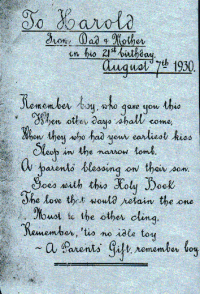
Reaching the age of twenty-one years is a memorable time to most people and to me it
was no exception. My parents wanted to celebrate the occasion by giving me a Bible and
on the fly-leaf were engraved the words shown in this re-production. Today I am very
conscious of the meaning in those words. On that occasion, too, I had my photo taken
as a gift from Jean and it was my pleasure to reciprocate when she reached twenty-one
years, just four months later. Both photos grace my wall today. Furthermore, it saw the
end of my six years’ apprenticeship and I was now a fully fledged tradesman (in those
days referred to as a journeyman) and my pay rose from £3/7/6 to £4/4/- but we were
in a depression so I was put on short time one week on and one week off — which gave
me £2/2/- per week.
Sport played a large part in my life and during my school days I managed to cement a
place in the cricket and football teams. After leaving school I eventually joined the I.O.R.
and at 15 years of age was invited to play in the cricket team of the Star of Northcote
Tent. My success was moderate for bowling was my only ability although, I must hasten
to add, that my fielding, too, was very good. However, going in to bat at 9, 10, 11 very
soon made me change direction, I decided to make myself a batsman and thus become
an all-rounder. Many, many hours of shadow batting in the back yard and many
experiments at practice soon taught me that if a person “puts his/her head down” they
can achieve what at first appears impossible. For a number of years I opened the batting
and eventually took over the number three spot. In my early 20's I held down the
positions of captain and coach for a number of seasons until I transferred to another
club where possibly I had my greatest success, both as a batsman and bowler, achieving
a reputation which is even spoken about in this year of 1993. In retrospect, my biggest
mistake was in refusing an invitation from Sub-District side Preston, for that grade of
cricket was the stepping-stone to District ranks which I would have loved.
Football was a different story. In his younger days my father first played for Northcote
in the VFA and followed this with a stint at Fitzroy where he played on the wing in the
2nd Eighteen until he went to West Australia. I wanted to do what my father did with
the hope that when I got to Fitzroy, it would eventually lead me into the 1st Eighteen
in the VFL. However, it was not to be! At 18 years of age, almost on the eve of starting
at Northcote, my left knee was seriously damaged in a game thus ending any playing
career I envisaged and the knee has bugged me since that time, even to ruling me out
of war-time service.
Prior to marriage, my courtship was a fairly long one — five years — but circumstance
at that time made it very difficult for couples to save sufficient for setting up a home.
It was the years of the Great Depression! On December 16th, 1933, just two days after
Jean’s birthday, we were married at Thornbury Salvation Army. With a guest list of 60
people, Jean’s father gave us £10 for expenses. The Home League did the catering,
giving us an account for £7/18/6, We were permitted to keep the change of £2/1/6. The
marriage celebrant was Colonel Tom Driscoll who, 24 years previously had dedicated
Jean at Norwood Salvation Army. When I gave him £2 for conducting the wedding, he
handed it back to us as a wedding present. It was a wonderful day with lovely sunshine
and a huge crowd filled the Hall for the wedding. We went to Mt Evelyn for our
honeymoon, the house being owned and loaned free of cost by Mr and Mrs Jack McKay
of Thornbury.
Two girls graced our home – Dorothy and Maralyn. We enjoyed so much their growing
up stages and were ultimately very proud of their achievements in all walks of life, and
more importantly in the conduct of their personal lives. Two girls who today, in my
declining years, continue to give me great joy and tremendous satisfaction in all their
ways. At the time when Dorothy was born in 1934, I take credit for an innovation which
became standard in prams. In those days women put a container on the framework
under the pram with the baby. Jean wasn’t happy with this situation and asked me to
do something better for her, so I made a drawer to the same contour as the pram,
painted it the same color, and it looked great. I showed it to a pram maker in
Thornbury, indeed where we had bought our pram. He very quickly produced prams
identical to my design and it wasn’t long before it was universal. In retrospect, I should
have patented the idea and so receive royalties.
I should tell you something about my lovely wife, Jean. She was the 9th child of Colonel
and Mrs Henry Sharp. Good looking, nicely built, intelligent and good natured, she was
the epitome of the type of young woman any man would be glad to marry. Her dress
sense, too, was first class. As the years went by I was amazed at her capacity to cope
with whatever circumstances arose, and the longer we were married the greater was my
appreciation of her as my partner in life. Back in those early 1930's, because there was
no household refrigeration, and indeed a lack of ice chests, it was necessary for women
to shop each day and most times, after paying the weekly “rent” and purchasing the
week-end provisions, there were only a few shillings left to carry through from Monday
to Friday. The capacity of women to stretch those few shillings was nothing short of
amazing, and Jean was no exception. We had a wonderful relationship throughout our
whole married life together and this became an even closer relationship when sickness
overcame her and we had to rely on each other so very much.
Possibly, now is the time to introduce you to some of the conditions we lived in during
those early days of our marriage. Our only hope of keeping the butter from melting on
the hot days, was to use a butter crock which was akin to a red pot plant turned upside
down with a knob instead of a hole. This was placed on a type of saucer of the same
material with a raised centre and a moat filled with water. It would hold 1lb. of butter.
This was all we could afford! After cooking meat, the left-over from the meal was put
in a meat safe and hung in the passageway or some cool spot for the air to supply any
cooling. Later the Coolgardie Cooler came on the market and it was certainly a great
innovation. They were made with an iron frame in the shape of a very large bird cage,
the sides and door draped with a fine hessian, a metal tray on top to contain water with
wicks taking the water down the sides to a tray underneath to catch the water as it
dripped from the hessian. The wet hessian kept food nice and cool in the Coolgardie
Cooler. We couldn't afford to buy one, so I made it as did many other men.
Wonderful! We managed to save enough to buy an Ice Chest. The ice man came twice
a week. He would look in your ice chest then go to his cart (it was horse and cart) in
which he had great blocks of ice which he would cut into sizes to suit your ice chest
using an ice pick. It cost us 3/- per week for ice. The children in the street would crowd
around the cart for when he cut the ice, chunks would fall and the children loved to
suck those chunks of ice.
In those days home deliveries of goods was a normal practice. The ice man, the grocer,
the greengrocer and even the milkman who called weekly for his money were all
confidently invited into the home by the housewife who gave no thought to being
molested. Today, the mind boggles at such confidence and it is sad that the time has
come when a woman must keep a locked door between her and the person on the
outside, be it man or woman.
Washing day for a woman was a real chore. The copper was heated by wood and the
clothes were cleaned by rubbing them on a scrubbing board prior to putting them into
the copper to boil. After boiling, the clothes were put through a “ringer” and then hung
on the line to dry in the sun. When washing machines were invented, they had a ringer
built on the top. We bought one, but after using it, Jean said it was unbalanced and
would fall on her. I was skeptical, but she was right, for eventually it did overbalance
and fall, but fortunately it did not injure her. Nevertheless I very quickly traded it in for
a new safe machine.
Having a bath, too, was a chore. Laundries were usually in an out building, but
fortunately ours was attached to the house. We had to boil the copper and carry the
water by bucket throughout the house to the bathroom, so it took a considerable time
to fill the bath. Later I ran a water pipe along the outside of the house connecting the
copper with the bath, thus saving a fair amount of time. Eventually we bought a chip
heater for the bath and later still, a gas heater.
When first married we had a wood stove and a “Main” gas stove. The “Main” was the
first model put out by the Gas Company. They were a favorite with the women.
Ultimately we removed both stoves and bought a modern bench model gas stove. In
those days you could have your time payment amount added to your gas bill. It was
the only way we could afford that stove.
In 1939 World War 2 broke out. I first tried for air crew, but because I was now 31 years
of age, that avenue of service wasn't open to me. At this time, I was offered a rise of 5/-
per week if I would not enlist, but because I made three attempts to join the militia the
rise never eventuated despite my being knocked back due to a faulty knee. That knock-back aggravated me because I was playing cricket. However, on the third attempt I gave
up trying. About six months later I receive a call from Victoria Barracks for an interview
with Flying Officer Less, later Squadron Leader, with the view to setting up a monotype
division in the Records Section of the Air Force. I declined on the grounds that it was
not my “cup of tea” to be a “base waller”. That was probably a wrong decision because
there is more to war than a gun in hand. Ultimately I joined up as an air raid warden
being attached to the first aid section.
The resolution I made in 1925 when 15 years of age came to pass in May 1948 when
with my friend, Sam Murphy, we became the proprietors of W. & J. Barr (Printers) of
Fitzroy, a printing firm founded in 1873 and recognised as the first suburban printer in
Melbourne. It was a well established business, but tremendously run down because
William Barr had not moved with the times, his age somewhat dictating the lack of
initiative. An interesting facet occurred during negotiations when Sam decided the risk
was too great and withdrew from the partnership. However, this was my opportunity,
so I indicated my determination to proceed and would find another partner. Sam was
so impressed by my attitude that he sought to rejoin the venture, this culminated in 28
years of a very harmonious partnership. The original business was at 105-107 Brunswick
Street, Fitzroy. We bought shops adjacent to the factory for extension, but Fitzroy
Council made things so difficult that we bought land at 424-430 George Street Fitzroy,
and in 1960 we moved into a factory designed to suit our business. In July 1976 we both
decided to retire so the business was sold to Globe Press. With the sale, the oldest
suburban printer in Melbourne became extinct.
As a lad I remember when radio was first introduced and many people were afraid of
it, thinking that lightning might strike through the aerial and burn the house down. We
had to put our radio (wireless) in the cart shed for that very reason. We had a crystal
set and to get the station it was necessary to move a cat’s whisker (so called) across the
crystal until you got good reception and because at the time I was the only one who
understood Morse Code in our house, it fell to me to say what was going on. Later
valve sets became the norm and many men purchased the components and made their
own sets.
My first scooter was a fixed head made by my father — a fixed head meant that it had
no pin on which the handles turned to right or left. Certainly a bit difficult to
manouevre. My first bicycle was a Dayton, made in America, and it was higher than the
normal bike. However, it would be worth a fortune today! It was given to me by a Miss
Belcher who lived in Agnes Street and to whom I used to deliver fruit and vegetables
from my father’s greengrocers shop. Oh, and she was one of my customers for cabbage
and cauliflower leaves for her fowls.
In 1978, with three other Salvationist printers, I was asked to attend a meeting with The
Salvation Army hierarchy to discuss the possibility of closing Citadel Press which was
financially embattled. With the majority of those present in favour of closure, Athole
Graham and myself fought to save the closure even to the extent of saying it could be
made viable once again. Who would do it? Of the four printers, I was the only one
retired! Commissioner Arthur Linnett invited me to his office and from that discussion
I undertook the task of getting Citadel Press back on its feet and also to find a
competent manager. I found things chaotic. To enable me to make the necessary
adjustments I sought the assistance of former employees, now retired, who would make
themselves available on daily notice should I need them. Fortunately, I never had to call
on them because the employees responded to the directions I insisted on implementing.
The atmosphere changed and production increased and we eventually turned the
corner. I then secured Raymond James as manager and stepped back into retirement.
About a year later, a lass who was senior in the office approached me with these words,
“Mr Jewell, when you came to Citadel Press I hated you for what you were doing.
However, later I realised what you were striving for so I felt a little better towards you.
Now I realise if you had not done the things you set out to do, the present manager
would not have been able to manage the place so successfully. I would now like to call
you, Uncle Harold.” I granted that privilege for I felt it was a great finale to my
management of Citadel Press.
* * * * * * * * * * * * * * * * * * * *
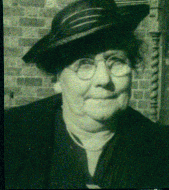 Harold’s Mother - Matilda Harold’s Mother - Matilda
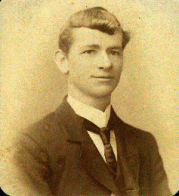 Harold’s Father - Ernest Harold’s Father - Ernest
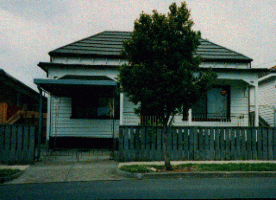 55 Darebin Road 55 Darebin Road
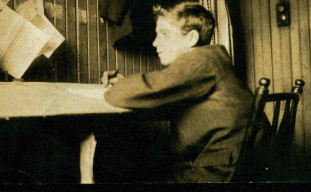 At 15 years of age I commenced in the reading room under the
direction of the head reader, Mr Jack Stevens. At 15 years of age I commenced in the reading room under the
direction of the head reader, Mr Jack Stevens.
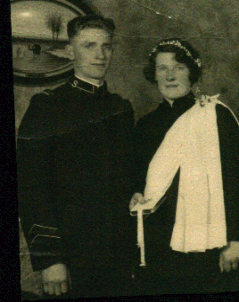 Harold and Jean 16/12/1933 Harold and Jean 16/12/1933
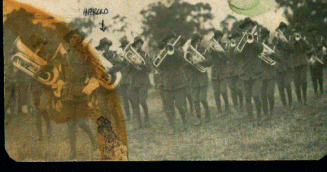 Seymour training days Seymour training days
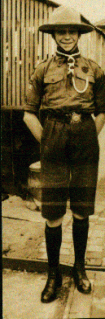 Harold’s Scouting days Harold’s Scouting days
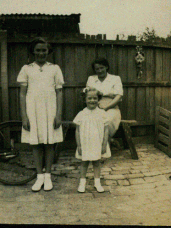 Dorothy, Maralyn, Jean Dorothy, Maralyn, Jean
| |